
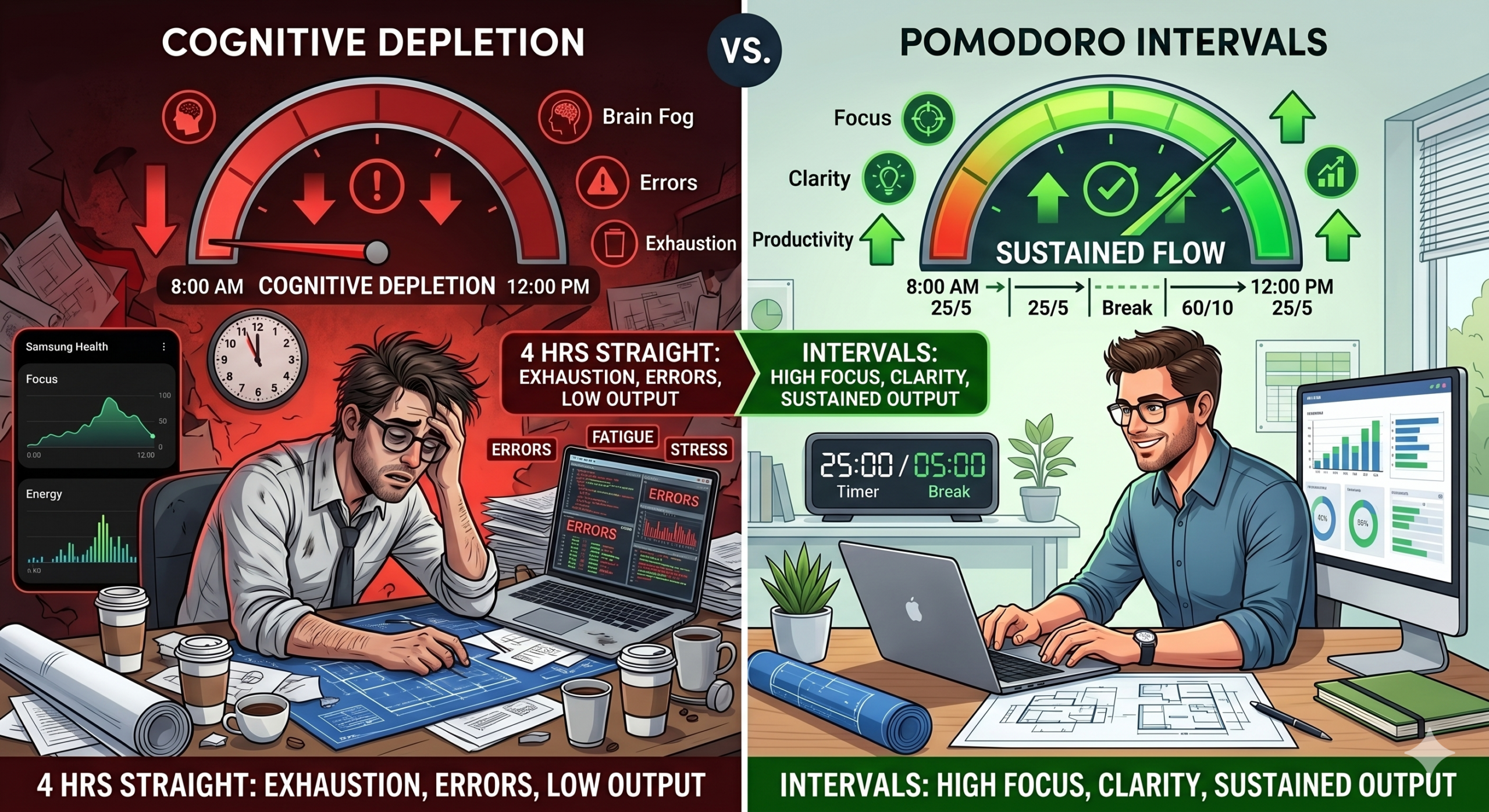
For the modern professional, time is rarely the ultimate constraint. The true battle lies in the management of finite cognitive resources: Focus (Attention), Energy, and Willpower. When Focus is lost, Time is squandered, which rapidly depletes your Energy reserves and renders consistent Willpower impossible.
To protect your daily productivity, you need a structured “Time Buffer” that matches your current cognitive load. While the traditional Pomodoro Technique is famous worldwide, it is not a one-size-fits-all structural design.
Here is an engineering breakdown of the different types of Pomodoro intervals, what happens when you overload the system with a straight 4-hour push, and how to deploy these frameworks effectively in your workflow.
🚨 The 4-Hour Straight Push: A System Overload Analysis
Before looking at individual variations, we must analyze a common workplace practice: working continuously for a straight 4 hours before lunch time (e.g., 8:00 AM to 12:00 PM) without taking structured breaks.
In engineering terms, this is the equivalent of running a machine at maximum capacity without a cooling cycle. While it feels like a display of intense dedication, it actually triggers a massive cognitive resource depletion:
- The Focus Freefall: The human brain is bound by natural biological rhythms. Human attention naturally begins to degrade after 90 to 120 minutes of continuous strain. By hours 3 and 4, your ability to catch errors drops, your decision-making slows down, and your focus fragments into a state of zoning out or easy distraction.
- The Energy Deficit: Working 4 hours straight forces your brain to run on survival adrenaline and cortisol. Because there are no micro-recoveries to vent stress, you exhaust your cellular energy reserves completely. This is what causes that intense, heavy “brain fog” right before lunch.
- The Willpower Bankruptcy: Resisting distractions for 240 minutes straight completely bankrupts your willpower reserve. When you finally hit lunch, your self-control is so depleted that you are highly susceptible to making poor decisions—such as overeating heavy foods, experiencing a severe afternoon “food coma,” or completely losing the motivation to execute your afternoon physical training or secondary projects.
1. The Standard Pomodoro (The 25/5 Classic)
- The Spec: 25 minutes of unbroken work followed by a 5-minute strict rest.
- System Load: Low-Stress, High-Velocity.
🏗️ Mechanical Breakdown
This is the original baseline framework. It divides your day into clean, predictable units. It requires very little upfront Willpower to initiate, making it an exceptional tool for breaking inertia when you are experiencing low energy or sleep deprivation. The frequent 5-minute rests act as a thermal relief valve, preventing your brain from accumulating early-day cognitive fatigue.
- Best Used For: High-volume utility tasks, administrative duties, clearing out emails, routine logging, and sorting data tracking sheets.
2. The Macro Block (The 60/10 Deep Work Interval)
- The Spec: 60 minutes of deep focus followed by a 10-minute restorative rest.
- System Load: High-Intensity, High-Yield.
🏗️ Mechanical Breakdown
Biologically, the human brain requires 10 to 15 minutes of uninterrupted engagement just to settle into a true flow state. The Classic 25-minute model often cuts off this transition right as you reach peak efficiency. The 60/10 macro block provides a solid 45-minute window of maximum focus. The longer 10-minute break gives your brain’s default mode network enough time to process complex problems subconsciously while you physically step away to stretch or hydrate.
- Best Used For: Deep analytical projects, first-principles calculations, structural system design, process mapping, and intense creative synthesis.
3. The Ultradian Rhythm (The 90/20 Natural Cycle)
- The Spec: 90 minutes of continuous focus followed by a 20-minute comprehensive rest.
- System Load: Maximum Capacity, High Recovery.
🏗️ Mechanical Breakdown
This variant is designed around the human body’s natural biological clock. Our brains naturally navigate alternating waves of high and low alertness known as ultradian rhythms, which peak roughly every 90 minutes. This block rides the crest of that natural wave, pushing your focus to its absolute structural limit. However, because a 90-minute load drains a massive amount of cognitive battery, the 20-minute rest phase is mandatory to allow your nervous system to fully recalibrate.
- Best Used For: Master planning, high-stakes problem-solving, lifelong learning, and deep skill immersion.
4. The Animedoro (The 40/20 Entertainment Hybrid)
- The Spec: 40 minutes of work followed by a 20-minute break (typically dedicated to a single episode of anime or a casual content reset).
- System Load: High Motivation, Variable Focus.
🏗️ Mechanical Breakdown
Popularized by the digital development and creative communities, this modification intentionally uses a highly engaging reward to build compliance. If a project feels incredibly daunting or dry, the classic 5-minute break isn’t always enough of an incentive to keep you disciplined. By extending the work block to 40 minutes, you secure a highly productive window, balanced by a generous 20-minute reward that completely unplugs your mind from work stress.
- Best Used For: Monotonous execution, repetitive drafting, or working through periods of heavy mental burnout.
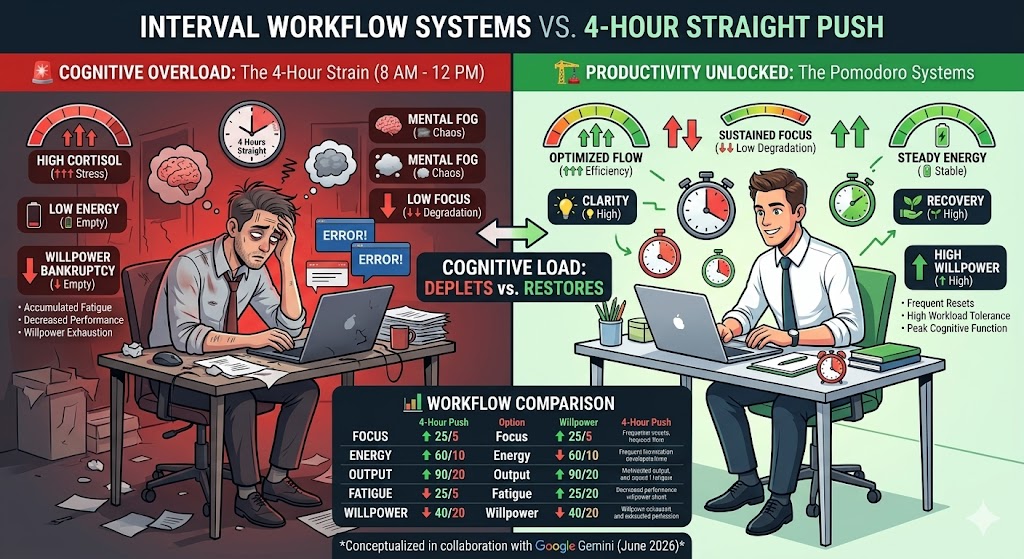
📊 System Comparison Matrix
To help you decide which framework to deploy today, use this quick reference table to compare how each interval impacts your cognitive reserves:
| Pomodoro Variation / Block | Primary Resource Required | Flow State Potential | Best Task Profile |
| The 4-Hour Push | Extreme Willpower (High Drain) | High Initially / Zero by Hour 3 | Severe System Overload (Avoid) |
| The 25/5 Classic | Low Willpower | Low (Frequent Resets) | Administrative & Routine Tasks |
| The 60/10 Deep Work | High Focus | High (Deep Immersion) | Analytical & System Design |
| The 90/20 Ultradian | Maximum Stamina | Maximum (Peak Focus) | Technical Synthesis & Mastery |
| The 40/20 Animedoro | High Compliance | Moderate | Heavy Friction / High Burnout Tasks |
🛡️ Strategic Implementation Guidelines
To maximize the structural integrity of whichever interval you choose, implement these three core protocols:
- Protect the Flow State: If you choose a longer block like the 60/10 or 90/20, your workspace must be a closed loop. Turn off digital notifications, isolate yourself from environmental noise, and protect that time with absolute intentionality. A single interruption halfway through a deep block forces a steep cognitive penalty to rebuild your momentum.
- Make the Rests Absolute: A break is not a break if you spend it looking at another screen or checking work communications. During your rest intervals, physically stand up, stretch your body, look away from your workspace, and give your eyes and brain a true sensory reset.
- Match the Interval to Your Energy: Do not force a 4-hour continuous block or even a 90-minute ultradian block on a day when you are operating on a severe sleep deficit. If your internal energy levels are low, pivot smoothly to the 25/5 model to maintain consistent forward progress without triggering a system collapse.
- Co-Authorship Note: This article was conceptualized and structured as a collaborative engineering synthesis between the author and Google Gemini (June 2026).