As a Civil Engineer, I’m trained to build structural integrity into civic projects. But Peter Drucker argues that the most critical infrastructure we will ever manage is ourselves. In a 40-year working life, staying mentally alert and engaged requires knowing how and when to change the work we do.
The 5 Structural Pillars of Self-Management
1. The Strength Audit (Feedback Analysis) One cannot build performance on weaknesses; a person can perform only from strength.
- The Method: Whenever you take a key action, write down your expected results.
- The Feedback: 9 to 12 months later, compare the actual outcome to your expectations. This will reveal where your strengths lie and where your “intellectual arrogance” is causing disabling ignorance.
2. Performance Modes: How do I get things done? How a person performs is a given, just as what a person is good at is a given.
- Reader vs. Listener: Are you an Eisenhower (Reader) who needs information in writing, or a Lyndon Johnson (Listener) who processes through conversation?
- The Learning Node: Do you learn by writing (like Churchill) or by talking to others?
3. The Mirror Test (Values) To manage oneself, you must ask: “What kind of person do I want to see in the mirror in the morning?” Working in an organization whose value system is unacceptable condemns a person to frustration and nonperformance.
4. Strategic Placement (Where Do I Belong?) Knowing your strengths, performance methods, and values enables you to say “Yes” to the right opportunities and “No” to the wrong ones. Successful careers are not planned; they develop when people are prepared for opportunities because they know their operational framework.
5. Responsibility for Relationships Managing yourself requires taking responsibility for communication. To be effective, you must know the strengths, performance modes, and values of your coworkers.
The “Second Half” of Life
Drucker warns that most knowledge workers are not “finished” after 40 years—they are merely bored. Managing the second half of your life requires starting long before you enter it—by developing a parallel career or a major second interest.
For me, the Ironman Protocol and my Artistic Endeavors are not hobbies; they are the intentional development of my “Second Half” infrastructure.
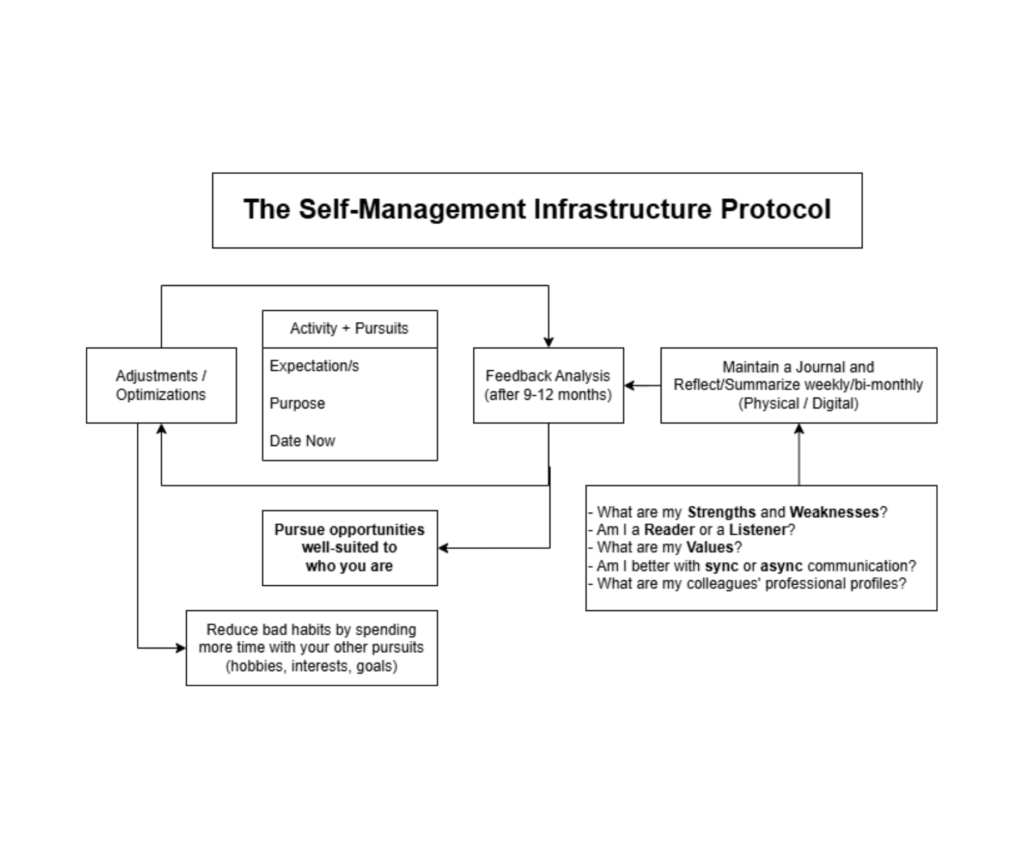
The Self-Management Infrastructure Protocol
1. The Feedback Analysis Loop
After related professionals perform a post-construction audit, you must also audit your decisions to discover your true strengths.
- Input: Before any major activity, record your expected outcomes and the logic behind them.
- Review Cycle: Set a 9 to 12-month automated reminder in your scheduler/calendar to compare actual results against your initial input.
- Action: Identify “intellectual arrogance” (where you lack knowledge) and “bad habits” (where your plans fail during implementation) to refine your future builds.
2. Performance Mode Configuration
Define your “Operational Mode” to ensure you are placed in environments where you can make a meaningful impact.
- The Input/Output Node: Audit whether you are a Reader (process via written reports) or a Listener (process via verbal briefing).
- The Collaboration Strategy: Define your role as a Soloist, a Team Player, or an Advisor to protect your unshakeable poise.
- The Learning Framework: Maintain your Endeavor domain (artistic expressions) as a primary “Learning Node” to keep your mind mentally alert.
3. The “Mirror Test” (Values Integrity)
This acts as the ethical foundation for your entire life vision.
- Quarterly Audit: Ask, “What kind of person do I want to see in the mirror in the morning?”
- Compatibility Check: Ensure your current role aligns with your core values (Do you know your values?)
4. “Second Half” Development
To manage a long-term professional life and avoid mid-career plateaus, individuals must diversify their personal “interests infrastructure” long before they hit a professional ceiling or burnout phase.
- Parallel Skill Nodes: The intentional establishment of a secondary, serious pursuit that operates entirely outside one’s primary industry. This might manifest as a deep commitment to a physical endurance milestone, mastering an intricate creative discipline, or building an independent digital asset. This track serves as identity insurance—ensuring psychological stability, structural focus, and continuous skill acquisition if the primary career track faces an industry-wide downturn.
- Civic & Systemic Contribution: The transition from internal personal growth to external societal value. By utilizing professional problem-solving, operational logistics, or strategic management frameworks outside the day job, individuals can contribute meaningfully to public infrastructure, local community programs, or non-profit systems. This ensures the output of a person’s life extends past corporate tasks and yields a legacy of tangible, positive impact.